
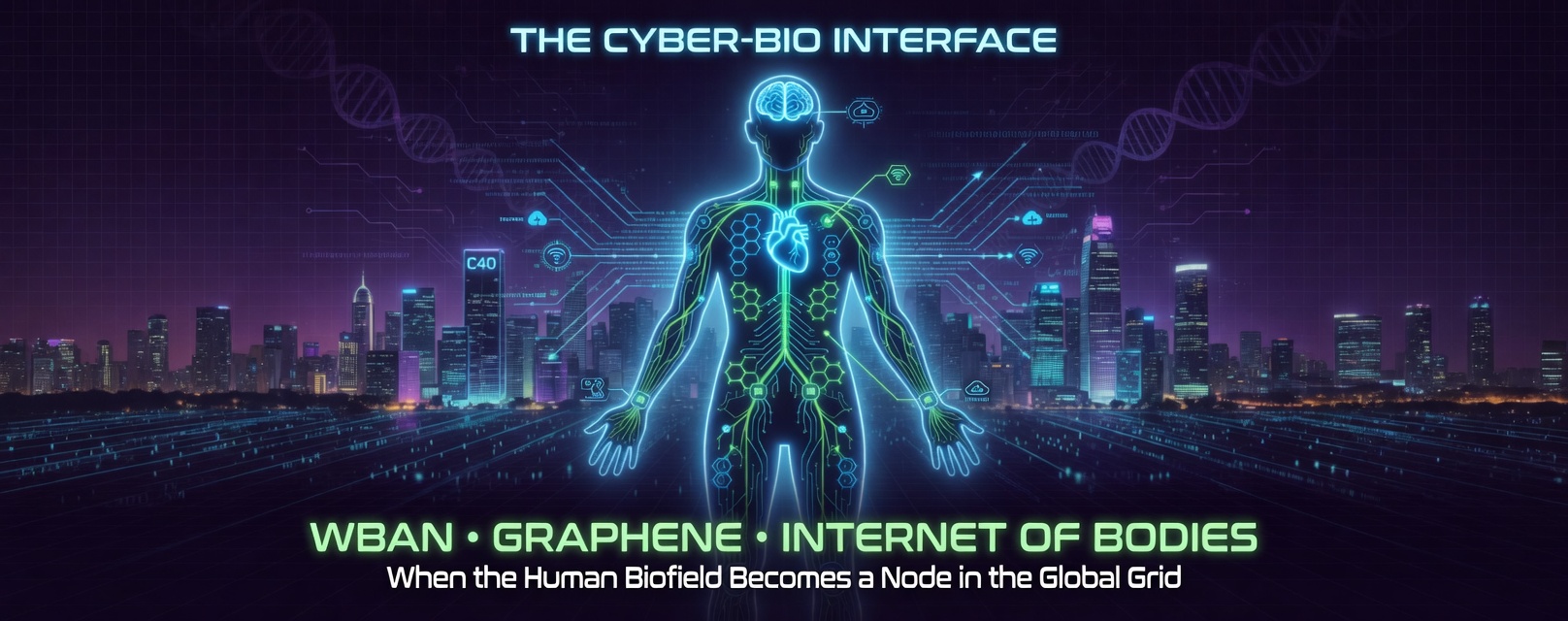
Former network engineer Sabrina Wallace has gained attention in alternative media circles for her detailed technical breakdowns of what she calls the “cyber-bio interface.” In viral video clips, Wallace describes how graphene-based biosensors, Wireless Body Area Networks (WBAN), and the human bioelectric field are being integrated into a global digital grid. She argues this goes beyond simplistic “bioweapon” or “mark of the beast” narratives, framing injections and synthetic biology tools as deliberate steps toward biodigital convergence tied to smart-city agendas like those of C40 Cities. Wallace emphasizes that the human body—via its natural electrical signaling and biofield—becomes a routable node for data, surveillance, and control in network-centric warfare. While Wallace’s personal background as a whistleblower with claimed experience in network infrastructure (dial-up to broadband transitions and Cisco systems) is self-described and not independently verified in mainstream sources, her core technical references align with established fields. WBAN, IoB (Internet of Bodies), graphene biosensors, and synthetic biology are real, documented technologies. Below is an examination of her claims alongside peer-reviewed research, patents, and real-world developments.
What Is Wireless Body Area Network (WBAN) Technology? WBAN is a legitimate IEEE standard (802.15.6) for short-range wireless networks of sensors placed on, in, or near the body. These networks enable continuous monitoring of vital signs (heart rate, glucose, ECG, respiration) without restricting movement. Sensors can be wearable, implantable, or even embedded in clothing, communicating data to gateways or the cloud for remote healthcare, rehabilitation, or military applications. Real deployments exist in medical settings. During the COVID-19 pandemic, researchers proposed and tested WBAN/IoT systems (e.g., CoV-BAN models) using wearable biosensors for real-time vital-sign tracking in home isolation or ICUs, achieving high packet delivery rates and low latency via protocols like LoRa. Hospital pilots have integrated WBAN for ICU patients and staff monitoring, transmitting data to cloud platforms like AWS IoT. Wallace highlights how the human biofield (bioelectric signals) could serve as the network backbone, turning bodies into “wireless sensors.” While speculative in scale, this echoes academic discussions of body-coupled communication and energy harvesting from bio-signals in WBAN research.
Graphene Biosensors and the Human Body as a Sensor Platform Graphene and its derivatives (graphene oxide, reduced graphene oxide) are widely researched for biosensors due to their conductivity, flexibility, biocompatibility, and high surface area. Wearable “graphene tattoos” or patches can non-invasively monitor sweat biomarkers, blood pressure, ECG/EMG/EEG signals, glucose, and more. Implantable versions are in development for chronic conditions. Recent examples include vertical graphene microneedle arrays for real-time ketone/glucose tracking in ketogenic diets (2024 study) and self-powered graphene sensors harvesting energy from sweat or movement. These align with Wallace’s description of biosensors routing data via the body. However, claims linking graphene oxide directly to COVID-19 vaccines have been repeatedly debunked by regulators (MHRA, FDA, EMA) and fact-checkers. No authorized vaccines list graphene materials; alleged detections (e.g., 2021 Campra report) were inconclusive and not peer-validated. Graphene oxide was used only in lab studies for spike-protein imaging, not as an ingredient.
Internet of Bodies (IoB) and Patents: Body Data as Currency The IoB extends the Internet of Things to human bodies across three generations: external wearables (Fitbits), internal implants (pacemakers, digital pills), and future “melded” brain-computer interfaces. Legal scholars like Andrea Matwyshyn have warned of privacy, liability, and autonomy risks, noting patents already signal rapid development. A prominent real incident is Microsoft’s 2020 patent (WO2020060606A1) for a cryptocurrency system that mines using “body activity data”—brain waves, body heat, or movement from tasks like viewing ads. It explicitly ties human physiology to blockchain validation, raising ethical questions about body-as-asset exploitation. RAND Corporation reports outline IoB opportunities in health but stress governance gaps in cybersecurity and data ownership.
Synthetic Biology, iGEM/BioBricks, and C40 Smart Cities iGEM (International Genetically Engineered Machine) is a global student competition using BioBricks—standardized DNA parts—for synthetic biology applications like biofuels, sensors, or therapeutics. It is fully open-source and legitimate, with thousands of teams engineering biology since 2003. C40 Cities, a network of nearly 100 mayors focused on climate action, promotes sensor networks for air quality, health co-benefits, and smart urban planning (e.g., real-time monitoring in San Francisco). While official documents emphasize carbon neutrality and resilience—not “biodigital convergence”—some analyses link IoT growth in smart cities to broader data ecosystems. No direct C40 policy endorses body-as-network tech.
Military and Government Programs: DARPA Bioelectronics DARPA’s real programs provide concrete links to Wallace’s electronic-warfare concerns. The 2025 BioElectronics to Sense and Treat (BEST) initiative funds “smart bandages” with high-resolution sensors for microbial/host signatures and automated treatment modules to prevent wound infections in warfighters. The BETR program develops adaptive bioelectronics for tissue regeneration using sensors, actuators, and AI. These demonstrate closed-loop body interfacing, though they are consensual, wearable/implantable, and targeted at military medicine—not covert mass deployment.
Implications and the Path Forward Wallace’s message—that awareness of the biofield and personal sovereignty offers resistance—resonates amid rapid tech convergence. Verifiable incidents (Microsoft patent, DARPA programs, graphene sensor trials, WBAN COVID pilots) show governments, corporations, and researchers actively developing body-linked digital systems for health, finance, and defense. Synthetic biology standards like BioBricks accelerate programmable biology. However, her assertion of widespread, non-consensual biodigital fusion via injections remains unsupported by evidence. No peer-reviewed studies or regulatory data confirm vaccine-enabled WBAN nodes. Real-world WBAN/IoB deployments require user consent, surgery, or wearables. As IoB matures, critical questions emerge: Who owns body data? How do we secure it against hacking? Regulatory frameworks (FDA cybersecurity guidelines, potential NIST-style IoB standards) lag behind innovation. Wallace’s technical deep-dives, grounded in IEEE standards and DoD references, serve as a call for informed public scrutiny rather than panic. The agenda may be real in its technological foundations, but empowerment lies in transparency, ethical governance, and reclaiming bodily autonomy amid the biodigital age. Watch the full clips, review the patents and papers, and decide for yourself—what role should the human body play in the global grid?