
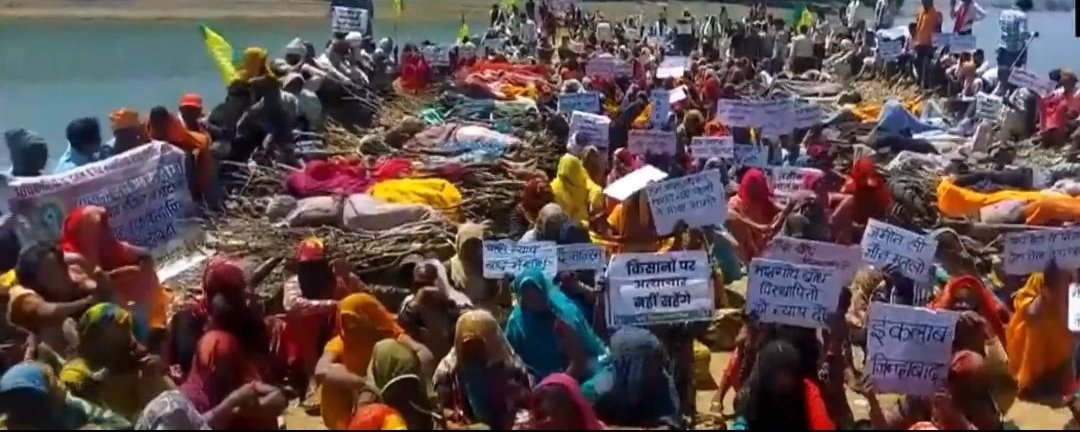
Tribals in Chhatarpur Launch ‘Chita Andolan’: Dramatic Protest Against Ken-Betwa River Linking Project Over Displacement and Compensation Chhatarpur, Madhya Pradesh, April 16, 2026 – In a powerful display of desperation and defiance, hundreds of tribal farmers – predominantly women and including small children – have been lying on symbolic funeral pyres as part of the ‘Chita Andolan’ in Madhya Pradesh’s Chhatarpur district. The protest targets the ongoing Ken-Betwa River Linking Project (KBLP), specifically the construction of the Daudhan (or Dhodan/Dhondhan) Dam, which protesters claim will submerge their ancestral villages, farmlands, and forests without fair compensation or proper rehabilitation. The dramatic sit-in on mock pyres, which entered its tenth day by mid-week, forms part of a broader multi-pronged agitation that has now stretched into its 11th day.
Protesters have also staged Jal Satyagraha (standing waist-deep in the Ken River), Mitti Satyagraha (smearing themselves with soil from their fields), and a ‘Panchtatva Movement’ to symbolise their unbreakable bond with land, water, and life itself. Slogans like “Justice or death” and “Burn us here or give us a new village” echo across the riverbank, underscoring the community’s resolve.
Background: The Ambitious Ken-Betwa Project Laid with the foundation stone by Prime Minister Narendra Modi on December 25, 2024, the ₹44,605 crore Ken-Betwa Link Project is India’s first major river-interlinking initiative. It aims to transfer “surplus” water from the Ken River in Madhya Pradesh to the drought-prone Betwa River in Uttar Pradesh through the Daudhan Dam and a 221-km canal network. Official claims project benefits including irrigation for over 10.62 lakh hectares of farmland, drinking water for 62 lakh people, and generation of 103–130 MW of hydroelectric and solar power – all targeted at reviving the water-scarce Bundelkhand region spanning Madhya Pradesh and Uttar Pradesh. However, the project has faced sustained opposition since its early planning stages in 2023, primarily due to large-scale submergence in the Panna Tiger Reserve and surrounding areas, affecting at least 24 villages in Panna and Chhatarpur districts. Critics, including environmentalists and locals, question the very premise of “surplus” water in the Ken basin and warn of irreversible ecological damage.
Core Reasons Behind the Protest Tribal communities, primarily farmers from Bundelkhand’s Adivasi belts, cite multiple grievances:
1. Inadequate Compensation and Rehabilitation: Protesters allege that the rehabilitation package is grossly insufficient. The administration has offered a collective ₹12.50 lakh per displaced family, with only about 40% disbursed so far. Many claim payouts fail to account for actual land value, standing crops, or alternative livelihoods. Age-determination discrepancies have also denied eligible adults (above 18) their rightful shares under the Land Acquisition Act, 2013.
2. Forced Displacement Without Consent: Villages face complete submergence, yet residents say they received little prior information or meaningful consultation. “Our forests, land, and homes are being taken away,” one protester told reporters. “It’s been 11 days and no officials have come.”
3. Livelihood and Cultural Loss: As primarily agrarian and forest-dependent tribals, families fear irreversible loss of farming income, grazing lands, and cultural heritage. Women, who form the backbone of the protests, highlight how displacement would push them into urban poverty without skills or support.
4. Environmental and Long-Term Concerns: The dam threatens biodiversity in the Panna Tiger Reserve and disrupts the local ecosystem, contradicting promises of sustainable development.
Conclusion :
While the project promises vital benefits—irrigation for over 10.62 lakh hectares, drinking water for 62 lakh people, and hydropower in drought-prone Bundelkhand—it underscores a classic development dilemma: balancing national infrastructure goals with the rights and livelihoods of indigenous populations whose ancestral lands and forests lie in the submergence zone (affecting 22+ villages and thousands of families).
As of mid-to-late April 2026, the immediate agitation has seen a temporary pause after local administration assurances of fresh surveys, better rehabilitation, and dialogue. However, underlying tensions persist, with protesters demanding genuine consent, fair land-for-land options where possible, and transparent implementation.
Ultimately, the success of the Ken-Betwa Project—and similar initiatives—will depend not just on engineering feats or economic projections, but on equitable resolution of ground-level grievances. Failure to address tribal concerns risks eroding trust, prolonging conflicts, and undermining the very sustainability the project seeks to achieve. A just outcome requires inclusive rehabilitation that respects both development needs and the dignity of affected communities.