May 30, 2025
As Sikkim marked its 50th anniversary of statehood in 2025, Prime Minister Narendra Modi joined the celebrations, highlighting the state’s remarkable journey and envisioning a bright future. This milestone, celebrated as ‘Sikkim@50’, reflects not only Sikkim’s integration into India in 1975 but also its growth as a model of development, sustainability, and cultural richness.
Sikkim’s path to becoming India’s 22nd state is a fascinating tale of geopolitics and transformation. Originally a sovereign kingdom under the Namgyal dynasty since the 17th century, Sikkim served as a buffer between British India, Tibet, and Bhutan. Its strategic location in the eastern Himalayas drew attention, and by 1890, it fell under British suzerainty. After India’s independence, this relationship evolved with the “India – Sikkim Peace Treaty” signed in December 1950, making Sikkim a protectorate. Under this agreement, India managed Sikkim’s external defense, diplomacy, and communication, while the kingdom retained internal autonomy.
Tensions mounted in the early 1970s amid political unrest and demands for reform. In April 1973, India assumed direct control, effectively ending the monarchy. A pivotal moment came on April 9, 1975, when the Sikkim Parliament declared the king deposed. A referendum followed, with 97% of voters favoring integration with India. On May 16, 1975, the Indian parliament officially welcomed Sikkim as a state. While the move was widely accepted, some debate persists, with critics pointing to India’s military presence and political pressures during the referendum. China’s recognition of Indian sovereignty over Sikkim in 2003 marked a diplomatic milestone, paving the way for initiatives like the proposed opening of Nathula and Jelepla Passes in 2005.
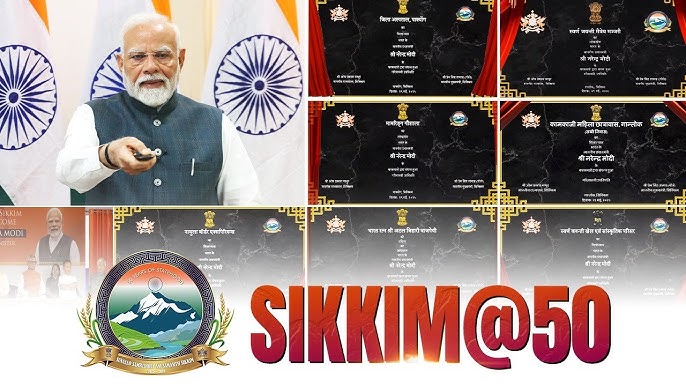
On May 29, 2025, Prime Minister Narendra Modi participated in the ‘Sikkim@50’ celebrations, a highlight of the state’s golden jubilee. Originally planned to address the event in person at Gangtok’s Paljor Stadium, Modi adapted to inclement weather and spoke virtually from Bagdogra, West Bengal. His address painted an ambitious vision, positioning Sikkim as a potential global tourism hub and sports powerhouse, while celebrating its achievements over five decades.
Modi lauded Sikkim as a “model of development with nature,” spotlighting its high per-capita income and pioneering 100% organic farming practices. He called it a “big garden of biodiversity,” rich in natural beauty, spiritual heritage from Buddhist monasteries, and a unique sense of peace—qualities he deemed unmatched in global tourism. The Prime Minister also inaugurated key projects, including the Pelling Ropeway to boost connectivity in rugged terrains and plans to develop Soreng district as India’s first organic fishery cluster, reinforcing Sikkim’s sustainable leadership.
Investment commitments from major industrialists were highlighted, promising jobs across the northeast, including Sikkim. Modi emphasized improved infrastructure, noting passenger ropeways as a solution where roads are impractical. Joined by Sikkim Governor Om Prakash Mathur and Chief Minister Prem Singh Tamang, the event saw the release of a ₹50 postage stamp, symbolizing Sikkim’s journey. Tamang extended an invitation for Modi to visit in person in October or November 2025, as the year-long celebrations continue.
Modi’s focus during Sikkim@50 underscores a strategic vision to harness the state’s natural and cultural wealth for tourism, sports, and economic growth. The emphasis on organic farming and sustainability aligns with global trends, positioning Sikkim as a leader in eco-friendly progress. Projects like the Pelling Ropeway address long-standing connectivity challenges in the mountainous region, promising to boost tourism and local economies.
Historically, Sikkim’s 1975 integration, while transformative, carries a complex legacy. The referendum’s overwhelming support cemented its place in India, but questions about political influences linger. Modi’s engagement shifts the narrative to the future, reinforcing national unity and development. A potential in-person visit later in 2025 signals sustained attention, likely spurring further investment and global recognition for Sikkim.
As Sikkim shines during its golden jubilee, it stands as a testament to unity, resilience, and the promise of a vibrant future.
Follow us on X